06 Feb, 2023
BINTURONGS: THE MYSTERIOUS NEIGHBOURS
BIODIVERSITY
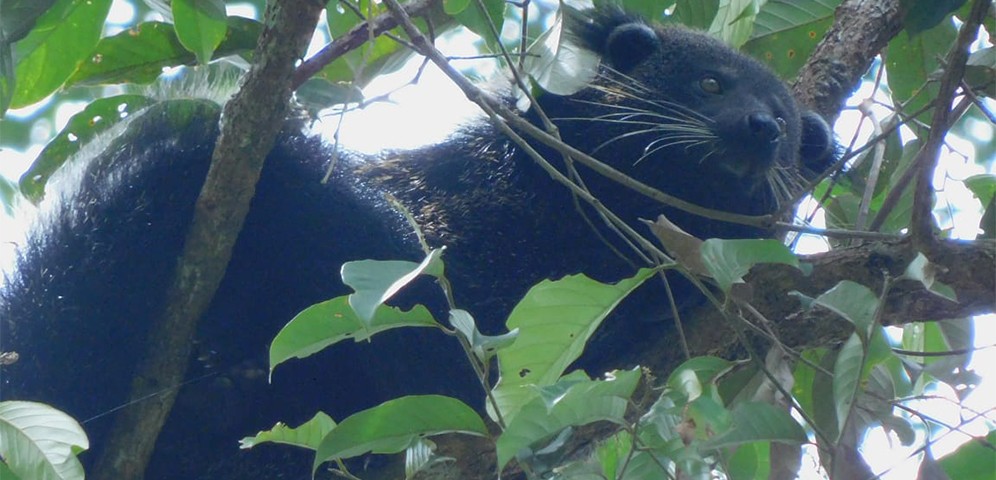
Our Post-Release Monitoring (PRM) team recently went in search of orangutans at Puncak Leke, in the Kehje Sewen Forest, during the cooler hours of the day. It was during this routine patrol that our team members caught sight of an unidentified animal. They took a closer look at the curious creature and noticed that it was rolled up with its head tucked into its body, making it difficult to see what it was.
For about an hour, our team waited for the animal to move or change its position, so they could see its face. After some time, the PRM team managed to capture a picture of the animal’s face, the length of its body, and the slightly curved shape of its paws. Finally, they were able to identify the animal in question as a binturong (Artictis binturong).
Binturongs were once thought to be nocturnal and mostly active at night, however, some researchers have also found that they are active during the day. This large civet-like animal, also referred to as a ‘bearcat’, is an omnivore and opportunistic eater that survives on almost anything it can find in the forest – plant shoots and leaves, fruit, eggs, birds, fish, small invertebrates, and small rodents.
The binturong is endemic to Southeast Asia and, in Indonesia, it is found in Sumatra, Java, and Kalimantan. On the island of Borneo, the binturong is distributed in lowland and hilly areas, as well as in upstream areas, including around the Kapuas and Mahakam rivers. The binturong has several unique physical features, such as a tail that can function as a fifth limb to grab tree branches and a ‘fake penis’ (pseudo-penis) appendage in females of the species.
According to the International Union for Conservation of Nature (IUCN), the binturong is listed as a species that is ‘vulnerable to extinction’, as its numbers have declined by more than 30% over the last 30 years due to poaching and the illegal wildlife trade. The Convention on International Trade in Endangered Species of Wild Flora and Fauna (CITES) also includes the binturong in its Appendix III list. In Indonesia, this species is protected by Regulation no. 7 of 1999, pertaining to the preservation of flora and fauna.
In order to preserve the binturong and prevent many other threatened species from becoming lost to this world forever, we, as a society, must help support the Indonesian and global protection efforts as best we can!
Text by: PRM Team at Camp Lesik, Kehje Sewen Forest, East Kalimantan
- Share
-

-